Check out what I am reading now.
From Cavity Caused By Eating Nutrion Bars And Energy Bars? - AOL Health at AOL Food
Sunday, October 18, 2009

Saturday, October 10, 2009
Salem loses Super Nationals

Monday, September 21, 2009
Tuesday, September 15, 2009
Town begs to die
TREECE JOURNAL
Welcome to Our Town. Wish We Weren’t Here.

Mark Schiefelbein for The New York Times
Mayor Bill Blunk, of Treece, Kan., is pressing for a federal buyout of the town.
By SUSAN SAULNY
Published: September 13, 2009
TREECE, Kan. — Mayor Bill Blunk sees no reason for sugar-coating his opinion when asked to describe this town.

Mark Schiefelbein for The New York Times
Buyouts closed the nearby town of Picher, Okla., above, where piles of mining waste dominate the scene.

Readers' Comments
Readers shared their thoughts on this article.
“It’s dead,” he said. “Wasted land.”
Almost anywhere else on the map, such bluntness could cost a politician re-election. But not here. Mr. Blunk has the near-unanimous support of the population, 140 people or so, who are perhaps singular among residents of municipalities in that they all want out of theirs.
“I’d be happy to go as anyone,” said Randall Barr, a retired sand company worker. “You can’t do anything with this land. What good is it?”
For most of the early part of the 20th century, this little city in the southeast corner of Kansas had the feel of a rollicking boom town, its prosperity coming from land rich in lead, zinc and iron ore. Part of a vast mining district where Kansas, Missouri and Oklahoma meet, Treece and its twin city across the Oklahoma state line, Picher, became the unofficial capitals of a zone that in its heyday produced more than $20 billion worth of ore — much of it used for weaponry to fight World Wars I and II.
But when the last of the mines closed in the 1970s, Treece was left sitting in a toxic waste dump of lead-tinged dust, contaminated soil and sinkholes. On a hot summer day, children can be seen riding their bikes around enormous mounds of chat — pulverized rock laced with lead and iron. It is the waste product left over from mining that is the cause of so many problems here. Uncontrolled, it blows in the wind.
Treece and Picher — which is the much larger of the two towns, once home to 20,000 people and separated from Treece by only a gravel road, the state line — became part of adjacent Superfund sites that the Environmental Protection Agency has been trying to clean since the 1980s.
In Picher, the remediation of the land has proved daunting. In a move without many precedents, the federal government decided to buy out and relocate nearly the entire population, which had dwindled to 1,800 by 2000, leaving a dusty ghost town where the social and economic hub of the area used to be.
But the buyouts stopped at the Oklahoma line. Treece remains similarly contaminated, but now even more isolated. Officials in Kansas have been practically begging the federal government to move Treece’s impoverished people, mostly the children and grandchildren of old miners, but to no avail.
“You can turn and see one block away is Oklahoma, unsafe,” said Pam Pruitt, the city clerk. “They got bought out, and we didn’t? It’s incredibly unfair. The people here, if they wanted to leave, they can’t. They can’t sell their property. They can’t get bank loans to fix them up. They’re just stuck.”
The E.P.A. does not see it that way. The agency favors rehabilitation of the tainted soil in Treece, which mainly entails cleansing the top layer of sediment.
Senator Pat Roberts, Republican of Kansas and a staunch advocate of the buyouts, said he likened the strategy to “throwing a fancy rug over a hole in the floor.” He believes that it would be more efficient to simply move the people, which would cost an estimated $3.5 million.
Nonetheless, the agency says that it can accomplish the soil cleansing in 10 years and that Treece residents are safe in the meantime. In Picher, however, government scientists found that extensive waste deposits could not be remediated for several decades, and that residents would be at risk during the cleanup, hence the need for government-assisted relocation.
“They are two independent sites from the way we look at it,” said Mathy Stanislaus, the assistant administrator for solid waste at the E.P.A.
Mr. Stanislaus said that in Picher, the residential areas were interspersed with mining waste sites, but that in Treece, the residential areas were away from pollutants. Still, he said, the agency is “taking a hard look” at the residents’ concerns and will continue to evaluate their situation.
Such explanations do nothing to ease the worry of the people in Treece. In addition to living in fear of lead and other poisons, they lost their stores, gas stations, some public services, jobs and their social outlet with the demise of Picher.
That town ceased to be an official entity on Sept. 1. Only a few die-hard residents remain, unconvinced of the health risks or unhappy with their buyout offers.
They live in a gothic landscape of varying degrees of disrepair. A few residents walked away from well-kept properties just last week, while most others took buyouts years ago, leaving dozens of houses to collapse upon themselves. Stray dogs wander. Faded signs announce places that are no longer: the Picher Mining Museum, the Church of the Nazarene, a 24-hour truck stop.
“I had a perfectly good house,” said Vickey Phillips, who moved out of Picher four years ago. “But they said it was full of lead.”
The psychological impact of Picher’s move on Treece has been overwhelming.
“They are in essence one town,” said Senator Sam Brownback, Republican of Kansas, who grew up north of Treece and is pushing for the buyouts. “Yes, there’s a state line that divides them, but that’s a man-made distinction. It is very much one town.”
About 100 miles northeast of Tulsa, Treece is entirely residential, with the only public building being its two-room clapboard City Hall. Most of the population, which has a poverty level more than twice the national average, is feeling increasingly depressed about the isolation and a sense of creeping abandonment.
“There’s nothing here but a City Hall, honestly,” said Regina Palmer, 24.
A 1993 study found that 34 percent of the children tested in Picher had blood lead levelsexceeding the point at which there is a risk of brain or nervous system damage. Government efforts to do something to clean the chat piles began in earnest then. But similar studies have never been done in Treece.
Only now is the E.P.A. testing the air quality and lead levels in residents’ blood. Agency officials arrived in town last week.
“It’s about 10 years too late,” Mayor Blunk said.
Glenda Powell is among those hoping for a buyout. “My father was one of the last miners,” she said. “He died of cancer, and so did my mom — bad lungs. This has always been home, and I don’t know where we’d go, just a place where we can breathe.”
Thursday, September 03, 2009
Super Nats 2010
SALEM - The date has been set for next summer's big car event, the Quaker City Super Nats.
Salem Mayor Jerry Wolford and Quaker City Raceway owner Dan Swindell announced their decision Wednesday to hold their events Thursday, June 10, through Sunday, June 13.
The event will include activities at the Quaker City drag strip followed by more events downtown throughout the evenings.
In a release, the men called the event the "first annual" and the date is a weekend earlier than the traditional date for the Steel Valley Super Nationals, which they recently announced a split from following the expiration of the final year of the contract with the previous promoters.
Wolford also announced Wednesday that Director of Public Service and Safety Steve Andres will serve as the After Party's overall coordinator. However, businesses, organizations and those individuals interested in participating and planning the event are invited to attend a meeting for the After Party, which will be set for a date later this month. Vendors and entertainers interested in participating have already begun to step forward, although many more will be needed.
Both Wolford and Swindell were eagerly discussing some possible plans for the upcoming event on Wednesday, although details are not yet being released.
The announcement came in contrast to rumors published on the Web site of the "Crusin' Times" that CORE Promotions was in discussions again with Swindell to renew the Steel Valley Super Nationals' contract.
Friday, July 31, 2009
Bubbles… Martha Says,
Blowing the perfect bubble depends on equal parts science and magic. With a few twists of wire, you can make fantastic bubble wands and spend long, lazy days practicing your technique. The best bubble solution is 10 cups water to 4 cups dish-washing liquid, plus 1 cup Karo corn syrup.
For large wands, you'll need plastic-coated wire coat hangers and either floral netting or plastic-coated chicken wire. Hold the hook at the top of the hanger, and pull the bottom down so that it forms a circle. Cut away the hook and twisted neck of the hanger with wire cutters; you should have about a 31-inch length of wire. With needle-nose pliers, twist a tiny hook into one end of the wire. Bend that end around, and hook it on the wire about 9 inches from the opposite end, forming a 7-inch-diameter circle. Squeeze the hook with pliers to fasten, and straighten the end to form a handle. Cut an 8-inch-diameter circle of floral netting. With pliers, fold the netting's edge tightly around the frame, snipping off any sharp ends.
For small wands, use 18-gauge cloth-covered wire cut to a length of 15 inches. Bend the wire into a lollipop shape, securing the end of the wire where the loop meets the handle with a dab of glue. To make a star, divide the circle into five even increments, then crimp with pliers. To make a heart, crimp only the top center of the circle. A tin can, with its top and bottom removed, also makes great bubbles -- carefully trim any sharp edges, dip one end in solution, and pull through the air to make one long bubble.
Thursday, July 30, 2009
And again!!!
ohnny Depp and Tim Burton to Vamp It Up in 'Dark Shadows'
by Matt McDaniel  July 29, 2009
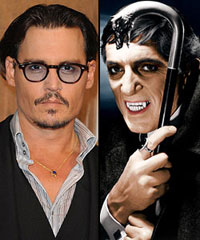 Three of the most talked-about things at Comic-Con last week were vampires ("New Moon" and "True Blood"), another movie pairing director Tim Burton and Johnny Depp ("Alice in Wonderland"), and updates of cult '60s TV shows ("Doctor Who" and "The Prisoner"). So how excited fans would get if all of those elements could be combined into one movie?
Apparently, we'll find out when Burton and Depp team up for the big-screen adaptation of "Dark Shadows," the Gothic soap opera about vampires, ghosts, and monsters that ran on ABC from 1966 to 1971. Burton confirmed this last Thursday when he presented footage from "Alice in Wonderland" to a capacity crowd at Comic-Con's cavernous Hall H. He said "Dark Shadows" would be his next project, "if I ever finish this one here."
Before Lestat, Angel, and Edward Cullen, there was Barnabas Collins, a 175-year-old vampire who stalked the town of Collinsport, Maine pining for his lost love. Originally, the character of Barnabas, played by Jonathan Frid, was only intended for a 13-week story arc on "Dark Shadows," but he caused such a sensation with viewers he became the lead character for the next four years. The show spawned two movies in the early '70s, a revived series in 1991, and a pilot that was not picked up for series in 2004.
Depp would play Barnabas, a role he told Collider.com has been "a lifelong dream for me." Depp has said he loved the show as a child: "I was obsessed with Barnabas Collins. I have photographs of me holding Barnabas Collins posters when I was five or six." Depp has been pursuing the movie adaptation for years, buying the remake rights through his production company, Infinitum-Nihil.
Burton has also spoken about his fascination with the original show. He told the Los Angeles Times, "It had the weirdest vibe to it. I'm sort of intrigued about that vibe." He also spoke about the recent influx of vampire movies: "It's like any great fable or fairytale, it's got a power to it... There's something symbolic about it that touches people in different ways."
While both Depp and Burton seem excited to start work on what will be their eighth collaboration, production might have to wait until after Depp finishes work on the fourth "Pirates of the Caribbean" movie. Disney's Head of Production Oren Aviv said in an interview with ComingSoon.net that filming will start in April or May of next year, with a release planned for 2011. Aviv says the intention for the next movie is to "scale it down, because we can't get bigger... I want to kind of reboot the whole thing and bring it down to its core, its essence, just characters."
So it may be a while before Depp bares his fangs as a vampire. If "Dark Shadows" also hits theaters in 2011, it could be up against the final "Twilight" film, "Breaking Dawn." But if it's delayed another year, audiences might be over their bloodsucker addiction. Still, it seems that if anyone can create a dark, atmospheric, and entrancing vampire tale, it would be Johnny Depp and Tim Burton. To preview the fantastic sights of their version of "Alice in Wonderland" coming next March, watch the teaser trailer below.
Thursday, July 23, 2009
What parent would let a child chew on their shoes?
Buster Brown Recalls 1.4 Million Children's Clogs
Email thisPosted Jul 22nd 2009 at 3:35PM by Bee-Shyuan Chang
Filed under: Style in the News

Buster Brown has recalled 1.4 million pairs of clogs. Photo: U.S. Consumer Product Safety Commission
According to a release published yesterday (July 21) by the U.S. Consumer Product Safety Commission, children's shoe wear company Buster Brown & Co. announced a voluntary recall 1.4 million pairs of clogs for kids.
The company has specifically focused on car-shaped footwear that features decorative wheels that can detach and possibly choke a child. Although no serious injuries have been reported, Buster Brown reps have received two reports that the wheel fallen off.
Manufactured in China, the shoes were carried at outlets such as Walmart and Amazon.com.
"Brown Shoe is committed to our customers' safety," said the company's president of wholesale Gary Rich in a written statement. "Once we realized that the wheel component could create a choking hazard among children, we volunteered to undertake the recall. We have partnered with the Consumer Product Safety Commission to ensure parents have the information they need to return the shoes for a full refund."
No bids on the Watergate
Published: Wednesday, July 22, 2009
Bidders don't bite on The Watergate Hotel
Bidders interested in The Watergate Hotel apparently didn't think the building was a steal.
The Washington, D.C.-based hotel, made famous in the Nixon era, went to auction Tuesday, but failed to attract a bid and has been taken back by the lender that holds the $40 million note on it.
PB Capital Corp. took back the property Tuesday after bidding opened at $25 million and there were no takers. The 30-day foreclosure notice, sent to hotel owner Monument Realty, expired Thursday.
The hotel, part of a larger Watergate complex, gained notoriety in the 1972 burglary that led to Nixon's resignation.
-- Associated Press
Monday, July 20, 2009
Wednesday, July 08, 2009
Leaf Silhouette
How to Make a Leaf Silhouette Portrait

Extra photos for bloggers: 1, 2
Forget photosynthesis. Leaves are for photo-projects-thesis!
Grab a photo and a leaf, and in few simple steps you can turn everyday foliage into a unique silhouette portrait of someone you love.
Simple and elegant, leaf silhouettes look great in a frame or on a book or a card.
So, as Biff would say, “make like a tree and get to work on a silhouette leaf portrait!”
How to Make Your Very Own Leaf Silhouette Portrait
INGREDIENT LIST

- A photo of someone in profile
- A big leaf
- Wax paper
- A stack of heavy books
- One pen
- X-acto knife
STEP ONE: PREP THE LEAF
 Once you’ve found the perfect leaf (we found your basic ivy to be a great size and thickness), store it between two sheets of wax paper near the bottom of a big stack of heavy books. This will keep your leaf from drying out all crinkly, rendering it useless for this project.
STEP TWO: OUTLINE YOUR SUBJECT
 Grab your profile photo and use a pen to draw a line around the figure you intend to cut out. This allows you to make imortant decisions about which fly-away hairs to include, or not, before you get to the tricky business of cutting…
STEP THREE: CUTTING OUT YOUR STENCIL
 Use an x-acto knife to cut out your subject, carefully following the line you just drew.
Word on the street is that some folks prefer to use the x-acto knife’s double-bladed cousin, Scissors, for this step. Just use what you’re most comfortable with.
STEP FOUR: TRACE ONTO THE LEAF
 Place your photo-stencil face down on the back of the leaf. Be sure to center the stem through the middle of your stencil. Take up your pen again, and trace around the stencil.
STEP FIVE: CUT IT OUT
 This is going to feel a lot like step three… Use an x-acto knife to cut out your subject, carefully following the line you just drew.
STEP SIX: PRESS THE LEAF
 Return your lovely leaf shilouette portrait to its place between wax paper at the bottom of a stack of books.
When it has finished drying out, it will be nice and flat. Voilá! Leafy silhouette portrait accomplished!
HERE IT IS:

TAKE IT FURTHER
- Frame a portrait of a friend and give it as a gift.
- Make a family tree with leaf shillouette portraits of the whole family.
- Write your contact info on a leaf silhouette self-portrait for a truly unique carte de’ visite.
- Glue one to the front of a birthday/thank you/arbor-day card.
Thursday, July 02, 2009
Code cracked 200 years later
By RACHEL EMMA SILVERMAN
For more than 200 years, buried deep within Thomas Jefferson's correspondence and papers, there lay a mysterious cipher -- a coded message that appears to have remained unsolved. Until now.
The cryptic message was sent to President Jefferson in December 1801 by his friend and frequent correspondent, Robert Patterson, a mathematics professor at the University of Pennsylvania. President Jefferson and Mr. Patterson were both officials at the American Philosophical Society -- a group that promoted scholarly research in the sciences and humanities -- and were enthusiasts of ciphers and other codes, regularly exchanging letters about them.

University of Pennsylvania Archives
Robert Patterson
In this message, Mr. Patterson set out to show the president and primary author of the Declaration of Independence what he deemed to be a nearly flawless cipher. "The art of secret writing," or writing in cipher, has "engaged the attention both of the states-man & philosopher for many ages," Mr. Patterson wrote. But, he added, most ciphers fall "far short of perfection."
To Mr. Patterson's view, a perfect code had four properties: It should be adaptable to all languages; it should be simple to learn and memorize; it should be easy to write and to read; and most important of all, "it should be absolutely inscrutable to all unacquainted with the particular key or secret for decyphering."
Mr. Patterson then included in the letter an example of a message in his cipher, one that would be so difficult to decode that it would "defy the united ingenuity of the whole human race," he wrote.
There is no evidence that Jefferson, or anyone else for that matter, ever solved the code. But Jefferson did believe the cipher was so inscrutable that he considered having the State Department use it, and passed it on to the ambassador to France, Robert Livingston.
The cipher finally met its match in Lawren Smithline, a 36-year-old mathematician. Dr. Smithline has a Ph.D. in mathematics and now works professionally with cryptology, or code-breaking, at the Center for Communications Research in Princeton, N.J., a division of the Institute for Defense Analyses.
A couple of years ago, Dr. Smithline's neighbor, who was working on a Jefferson project at Princeton University, told Dr. Smithline of Mr. Patterson's mysterious cipher.
Dr. Smithline, intrigued, decided to take a look. "A problem like this cipher can keep me up at night," he says. After unlocking its hidden message in 2007, Dr. Smithline articulated his puzzle-solving techniques in a recent paper in the magazine American Scientist and also in a profile in Harvard Magazine, his alma mater's alumni journal.
The "Perfect" Cipher?

The code, Mr. Patterson made clear in his letter, was not a simple substitution cipher. That's when you replace one letter of the alphabet with another. The problem with substitution ciphers is that they can be cracked by using what's termed frequency analysis, or studying the number of times that a particular letter occurs in a message. For instance, the letter "e" is the most common letter in English, so if a code is sufficiently long, whatever letter appears most often is likely a substitute for "e."
Because frequency analysis was already well known in the 19th century, cryptographers of the time turned to other techniques. One was called the nomenclator: a catalog of numbers, each standing for a word, syllable, phrase or letter. Mr. Jefferson's correspondence shows that he used several code books of nomenclators. An issue with these tools, according to Mr. Patterson's criteria, is that a nomenclator is too tough to memorize.
Jefferson even wrote about his own ingenious code, a model of which is at his home, Monticello, in Charlottesville, Va. Called the wheel cipher, the device consisted of cylindrical pieces, threaded onto an iron spindle, with letters inscribed on the edge of each wheel in a random order. Users could scramble and unscramble words simply by turning the wheels.
But Mr. Patterson had a few more tricks up his sleeve. He wrote the message text vertically, in columns from left to right, using no capital letters or spaces. The writing formed a grid, in this case of about 40 lines of some 60 letters each.
Then, Mr. Patterson broke the grid into sections of up to nine lines, numbering each line in the section from one to nine. In the next step, Mr. Patterson transcribed each numbered line to form a new grid, scrambling the order of the numbered lines within each section. Every section, however, repeated the same jumbled order of lines.
The trick to solving the puzzle, as Mr. Patterson explained in his letter, meant knowing the following: the number of lines in each section, the order in which those lines were transcribed and the number of random letters added to each line.
The key to the code consisted of a series of two-digit pairs. The first digit indicated the line number within a section, while the second was the number of letters added to the beginning of that row. For instance, if the key was 58, 71, 33, that meant that Mr. Patterson moved row five to the first line of a section and added eight random letters; then moved row seven to the second line and added one letter, and then moved row three to the third line and added three random letters. Mr. Patterson estimated that the potential combinations to solve the puzzle was "upwards of ninety millions of millions."
![[Thomas Jefferson]](http://s.wsj.net/public/resources/images/HC-BE245_Jeffer_BV_20090701173440.gif)
Thomas Jefferson
After explaining this in his letter, Mr. Patterson wrote, "I presume the utter impossibility of decyphering will be readily acknowledged."
Undaunted, Dr. Smithline decided to tackle the cipher by analyzing the probability of digraphs, or pairs of letters. Certain pairs of letters, such as "dx," don't exist in English, while some letters almost always appear next to a certain other letter, such as "u" after "q".
To get a sense of language patterns of the era, Dr. Smithline studied the 80,000 letter-characters contained in Jefferson's State of the Union addresses, and counted the frequency of occurrences of "aa," "ab," "ac," through "zz."
Dr. Smithline then made a series of educated guesses, such as the number of rows per section, which two rows belong next to each other, and the number of random letters inserted into a line.
To help vet his guesses, he turned to a tool not available during the 19th century: a computer algorithm. He used what's called "dynamic programming," which solves large problems by breaking puzzles down into smaller pieces and linking together the solutions.
The overall calculations necessary to solve the puzzle were fewer than 100,000, which Dr. Smithline says would be "tedious in the 19th century, but doable."
After about a week of working on the puzzle, the numerical key to Mr. Patterson's cipher emerged -- 13, 34, 57, 65, 22, 78, 49. Using that digital key, he was able to unfurl the cipher's text:
"In Congress, July Fourth, one thousand seven hundred and seventy six. A declaration by the Representatives of the United States of America in Congress assembled. When in the course of human events..."
That, of course, is the beginning -- with a few liberties taken -- to the Declaration of Independence, written at least in part by Jefferson himself. "Patterson played this little joke on Thomas Jefferson," says Dr. Smithline. "And nobody knew until now."
Write to Rachel Emma Silverman at rachel.silverman@wsj.com
Wednesday, July 01, 2009
Yikes
Sears Tower unveils 103rd floor glass balconies

 AP – Anna Kane, 5, of Alton, Ill. lays down on 'The Ledge,' the new glass balconies suspended 1,353 feet (412 …
By KAREN HAWKINS, Associated Press Writer – Wed Jul 1, 5:05 pm ET
CHICAGO – Visitors to the Sears Tower's new glass balconies all seem to agree: The first step is the hardest.
The balconies are suspended 1,353 feet in the air and jut out four feet from the building's 103rd floor Skydeck. Their transparent walls, floor and ceiling leave visitors with the impression they're floating over the city.
"It's like walking on ice," said Margaret Kemp, of Bishop, Calif., who said her heart was still pounding even after stepping away from the balcony. "That first step you take — 'am I going down?'"
Kemp was among the visitors who got a sneak preview of the balconies Wednesday. "The Ledge," as the balconies have been nicknamed, open to the public Thursday. Visitors are treated to unobstructed views ofChicago from the building's west side and a heart-stopping vista of the street and Chicago River below — for those brave enough to look straight down.
John Huston, one of the property owners of the Sears Tower, even admitted to getting "a little queasy" the first time he ventured out. But 30 or 40 trips later, he's got the hang of it.
"The Sears Tower has always been about superlatives — tallest, largest, most iconic," he said. "Today is also about superlatives. Today, we present you with 'the Ledge,' the world's most awesome view, the world's most precipitous view, the view with the most wow in the world."
The balconies can hold five tons, and the glass is an inch-and-a-half thick, officials said. Sears Tower officialshave said the inspiration for the balconies came from the hundreds of forehead prints visitors left behind on Skydeck windows every week. Now, staff will have a new glass surface to clean: floors.
"It's very scary, but at the same time it's very cool," said Chanti Lawrence of Atlanta, adding that she's made her first step toward overcoming her fear of heights.
Adam Kane, 10, of Alton, Ill., rushed to the ledge with his friends and siblings, and they each eagerly pressed their faces to the glass bottom.
"Look at all those tiny things that are usually huge," Adam said.
The balconies are just one of the big changes coming to the Sears Tower. The building's name will change to Willis Tower later this summer. Last week, officials announced a 5-year, $350 million green renovation complete with wind turbines, roof gardens and solar panels.
With the ledge, visitors like Kemp said the nation's tallest building has succeeded in creating something they've never seen before.
"I had to live 70 years for a thrill like this," she said.
Tuesday, June 23, 2009
Directly from Kodak
KODACHROME Discontinuation Notice
KODACHROME 64 Film / KR
KODACHROME Discontinuation:
Eastman Kodak Company announced on June 22, 2009 that it will discontinue sales of KODACHROME Color Film this year, concluding its 74-year run as a photography icon. Sales of KODACHROME, which became the world's first commercially successful color film in 1935, have declined dramatically in recent years as photographers turned to other films or digital capture. Today, KODACHROME represents just a fraction of one percent of Kodak's total sales of still-picture films.
Despite all its outstanding features, KODACHROME involves a highly complex development process that led photographers to experiment with and adopt newer KODAK films that deliver outstanding color images through a simpler workflow.
Although KODACHROME has very distinct characteristics and no film will give the exact same results, current users are encouraged to try other Kodak films. Kodak continues to bring innovative new film products to market, having released seven new professional films -- over the last three years alone.  KODAK PROFESSIONAL PORTRA 160NC and VC Film KODAK PROFESSIONAL PORTRA 400 NC and VC Films KODAK PROFESSIONAL PORTRA 800 Film KODAK PROFESSIONAL T-MAX 400 Film KODAK PROFESSIONAL EKTAR 100 Film

Q&As:
- Why has Kodak decided to stop offering KODACHROME?
- Due to declining customer demand for KODACHROME, continued production of this film in no longer viable. Over the years people have moved from KODACHROME to other methods of capture, be it new films or digital. Simply put, not enough people are shooting KODACHROME for us to continue offering it.
- What are recent sales of KODACHROME?
- KODACHROME currently represents a fraction of 1% of Kodak’s still film sales. While KODACHROME is a truly iconic product that has served photographers very well for 74 years, the simple truth is that people have moved on and are no longer purchasing it in sustainable volumes.
- How long will Dwayne’s continue processing KODACHROME?
- Dwayne’s has informed us they plan to continue to process KODACHROME through December 31, 2010
Dwayne's Photo Service
415 S. 32nd Street
Parsons, KS 67357
(620) 421-3940
Toll Free: 1-800-522-3940
Fax: (620) 421-3174In Europe, where KODACHROME Film is sold along with a prepaid mailer, Kodak will continue to accept those mailers for processing through November 30, 2010.
Kodak Photo Service SA
Case Postale
Ch-1001 Lausanne
Switzerland, CH
- How long will Kodak continue to accept KODACHROME (PK) processing mailers, which were sold separately in the U.S.?
- In the U.S., Kodak will continue to accept PK processing mailers though December 31, 2009, provided the mailer has a valid expiration date or no expiration date. Expired mailers will not be accepted.
- How long do you expect the current supply to last?
- Based on usage patterns, we expect KODACHROME to remain on store shelves until the early Fall 2009.
- What product do you recommend KODACHROME shooters transition to once it is no longer available?
- There’s no doubt that KODACHROME is a unique look, and no film will give the exact same results. That said, we believe KODAK PROFESSIONAL EKTAR 100 Film andKODAK PROFESSIONAL EKTACHROME Film E100G offer features that current KODACHROME shooters would appreciate.
Monday, June 22, 2009
Kodachrome Two
Kodachrome film retired by Eastman Kodak; brand was color film's first commerical success
BYOLIVIA SMITH
DAILY NEWS STAFF WRITER
Monday, June 22nd 2009, 11:10 AM
 Duprey/AP
The Eastman Kodak company is retiring its iconic Kodachrome brand.
With apologies toPaul Simonand his hit song, theEastman Kodakcompany is taking Kodachrome film off the market this year.
Based in Rochester New York, the company made the announcement Monday, saying it was a hard decision to retire the famous brand.
"KODACHROME Film is an iconic product and a testament to Kodak’s long and continuing leadership in imaging technology,” saidMary Jane Hellyar, the president of Kodak's film, photofinishing and entertainment division.
"It was certainly a difficult decision to retire it, given its rich history. However, the majority of today's photographers have voiced their preference to capture images with newer technology – both film and digital."
Introduced in 1935, Kodachrome became the first color film to score large-scale commercial success.
But as many photographers switch to digital, the groundbreaking Kodachrome accounts for only a fraction of a percent of the company's revenues from still-picture films.
Kodak, a pioneer in photography, has had more than its share of hiccups in adjusting to digital technology. Its stock has declined and the company went through waves of layoffs and plant closings well before the current recession took root.
Among the images captured with Kodachrome that have gone on to become cultural artifacts themselves, photographerSteve McCurryused the film to create hisNational Geographiccover photo of a young Afghan girl, which became an instantly recognizable symbol of that country's plight in 1985.
If images created with the film itself fail to cement it's place in history, Paul Simon immortalized it in his 1973 hit, singing of its "nice bright colors/They give us the greens of summers/Makes you think all the world's a sunny day, Oh yeah ... Mama don't take my Kodachrome away."
Goodbye Dear Friend
Kodak Discontinues Kodachrome Film Amidst Barrage of Terrible Paul Simon Jokes
By John Herrman, 12:40 PM on Mon Jun 22 2009, 20,832 views
We get it, Associated Press, Paul Simon wrote a popular song with the word "Kodachrome" in it. But that's only a tiny—ifannoying catchy—part of the film's tremendous legacy, which stretches back to 1935.
On a technical level, Kodachrome—the first truly popular color film—is a dinosaur, requiring color to be added during development in a process which a particularly charitable technician might call "exacting." Nonetheless, for decades many photographers swore by the format for its color accuracy, versatility, and pedigree. Today, just one lab still processes the film, and it makes up less than one percent of Kodak's total still film sales, which, let's face it, probably aren't very high right now.
What sounds like a boring, inevitable "death of film" story at first is transformed into something of a tragedy with context—a favorite of motion and still film professionals, Kodachrome film is behind some of the most iconic images of our, our parents', and our grandparents' times: Steve McCurry's famous "Afghan Girl" photo for National Geographic, above, was shot on the film, as was Zapruder's video of Kennedy's assassination. (See this interview for McCurry's thoughts on Kodachrome). Kodak has assembled a gallery of the film's greatest hits, excerpted here. It's fairly spectacular, even to a child of the digital age. [AP]
June 22, 2009
A Tribute to KODACHROME: A Photography Icon
They say all good things in life come to an end. Today we announced that Kodak will retire KODACHROME Film, concluding its 74-year run.
It was a difficult decision, given its rich history. At the end of the day, photographers have told us and showed us they've moved on to newer other Kodak films and/or digital. KODACHROME Film currently represents a fraction of one percent of our film sales. We at Kodak want to celebrate with you the rich history of this storied film. Feel free to share with us your fondest memories of Kodachrome.

© Steve McCurry
Sharbat Gula, Afghan Girl, at Nasir Bagh refugee camp near Peshawar, Pakistan, 1984.
I've had the profound privilege of working with the world's greatest photographers in my role here at Kodak. I serve as the company's liaison with the pro community, and I've gotten to know the best of the best. Each one has their Kodachrome story.
I thought I'd share with you some reflections on Kodachrome from a small sampling of these great artists - Steve McCurry, Eric Meola, and Peter Guttman.
Listen to what Steve and Peter have to say as they reflect back:
"Before digital, Kodak was already shifting gears--moving away from the boundaries of KODACHROME (long lab times, fewer labs, a more environmentally friendly, as well as constrained, chemistry)" said Meola. "E100SW and E100VS were a natural evolution of the KODACHROME look, and made my life a lot easier. And they kept all the great things about KODACHROME --long latitude, fine grain, great color--and made it easier for me to get processed anywhere. In some ways, those films were natural predecessors to the digital age."
Steve McCurry, whose picture of a young Afghan girl captured the hearts of millions of people around the world as she peered hauntingly from the cover of National Geographic Magazine in 1985, offered these words:
"The early part of my career was dominated by KODACHROME, and I reached for that film to shoot some of my most memorable images," said McCurry. "While KODACHROME Film was very good to me, I have since moved on to other films and digital to create my images. In fact, when I returned to shoot the 'Afghan Girl' 17 years later, I used Kodak's E100VS film to create that image, rather than KODACHROME Film as with the original." 
© Peter Guttman
From Peter Guttman: "Kodachrome was for me the visual crib in which my photographic dreams and visions were nurtured. The rich hues, and startlingly lifelike textures imbued within this elegantly crafted film provided a vivid training ground for sharpening my vision of the world. The initial draw to Kodachrome was its unrivalled archival durability, but I shortly realized the magnificent renderings of reality that the film was capable of. I credit Kodachrome as my most reliable tutor, educating my eyeball with an awareness of the delicacy of light and the subtleties of color.
With the strict discipline of a Kodachrome vision firmly under my belt, I felt free to playfully experiment with other films. I have in recent years become enamored with Ektachrome 100VS which has now become my film of choice for its dazzling hues, deeply saturated color and intense sharpness--all optical tools that serve me well in portraying our planet's stunning diversity."
View our slideshow of great KODACHROME moments. 
© Eric Meola
"There are in life a few constants, but far too few. The sun rises in the morning and sets at night, and Kodachrome was what was always there to help us record those sunrises and sunsets and to brilliantly capture that ephemeral distance between light and shadow.
We would win awards with it, and the images that the light burned into its emulsion were a paean to this film, as much as the film was part of the soul of the photographers who used it and the unparalleled images they made with it.
We waited up nights to open those golden boxes--like young children surprised with glee and knowing we could drift asleep again and that all was right with the world, and that th
June 22nd, 2009, 7 AM Eastern Standard time:
Today, Eastman Kodak Corporation has officially announced the retirement of Kodachrome 64, the last remaining variation of legendary Kodachrome Color Film. This includes both consumer 135 KR-64-36 and professional 135 PKR-64-36 versions. However, Kodak and the only remaining lab in the world that develops Kodachrome have contracted to honor customer's requests for Kodachrome processing until at least 12/31/2010. In addition to this support, Kodak has stated that in current production and supply, Kodachrome film should be available until early Fall of this year with distribution that is considerate to all who would want to use it.*
This presents the public with a unique opportunity to still experience the film first hand before it is too late, with it’'s 75th anniversary being well within reach of Kodachrome fans next year.*
“"Kodachrome Film is an iconic product and a testament to Kodak’'s long and continuing leadership in imaging technology",” said Mary Jane Hellyar, President of Kodak’'s Film, Photofinishing and Entertainment Group. "It was certainly a difficult decision to retire it, given it's rich history. However, the majority of today's photographers have voiced their preference to capture images with newer technology,– both film and digital. Kodak remains committed to providing the highest-performing products –both film and digital –to meet those needs.”"
As cited in a press release given by Kodak this morning, Kodachrome Film in current use now represents just a fraction of one percent of Kodak’'s total sales of still-picture films. Anonymous sources say that in the early 1980's, there were 10 Kodak owned K-14 labs in the US. There were about 30 independent K-14 labs. There were also a number of labs in Europe and some in Asia totaling as many as 36 labs in Kodachrome's heyday. as the process is unlike any other film. The unique factor being that unlike most film processing being the normal 3-7 reasonably controllable steps, “Kodachrome film processing requires what is basically an in house chemist to attend to the no less than fourteen distinct steps to finalize the image. Single Kodachrome lab installations have been known to reach $500,000 for some of the largest operations.*Now there is just one remaining lab in the world in the heartland of the United States.
Yet despite these profound statistics, for over 7 decades, Kodachrome film has remained one of the most prominant photographic icons in pop-culture history. As the brainchild of two musicians partnered with Kodak, Kodachrome FIlm was a standing ovation hit right from it’'s introduction in 1935. So by the time musician Paul Simon released the hit song “"Kodachrome”" in 1973, the thousands of images that had appeared in powerfully storied magazines had drastically changed the way the world viewed the photograph, and the home movie or slide show had become the event for a Saturday night in homes for decades. Some of the photography accomplished on Kodachrome film has represented one of the highest standards of photojournalism in history from the the Great Depression era photographers such as Dorothea Lange, Walker Evans and Russell Lee to the thousands of images in magazines such as Life and national Geographic. One of the more memorable recent Kodachrome images is Steve McCurry’'s piercing 1985 National Geographic cover called “Afghan Girl”. In a movement that resonates corporation'’s recognition of the Kodachrome product as an era, Kodak will donate the last rolls of the film made to the George Eastman House of Photography and Film with Steve McCurry shooting one of those last rolls as a donation it self.*
“"The early part of my career was dominated by Kodachrome Film, and I reached for that film to shoot some of my most memorable images",” said McCurry. “"While Kodachrome Film was very good to me, I have since moved on to other films and digital to create my images. In fact, when I returned to shoot the ‘"Afghan Girl’" 17 years later, I used Kodak Professional Ektachrome Film E100VS to create that image, rather than Kodachrome Film as with the original."” In addition to creating newer films that have enabled photographers like McCurry to make powerful images more efficiently and with more options for stable processing, Kodak has recently introduced new consumer films like the recent hit “Ektar 100” Color Negative film and two new motion picture films in the past three years in the form of “Vision2” and “Vision3” motion picture stocks.
But as these new films and even digital start to gain on Kodachrome in terms of technical quality and easily surpass the iconic medium in ease of use, attention is starting to turn on to several unique attributes of the decades old film that is the only photographic medium to have a State Park named after it. Only a month ago, Sports Illustrated released a book called “"Slideshow”" that presents some of the more memorable images from their vast archive shot on slide film. this has been presented in a manner of the total scope of story telling as the slide mounts themselves bear the labels & handwriting of an illustrious journey as they tell a different story in addition to the actual photograph. Many of the images in the magazine’'s archive were shot on Kodachrome and simply appear as the entire slide on the page, labels and scribbles included with an accompanying essay. One of the most profound things about Kodachrome in recent times is that it has been shown very consistently that with reasonable care, the quality of the movies and photographs from professionals and amateurs made with the film can last several lifetimes with virtually no fading whatsoever. This has enticed individuals and magazines to examine their collections and those of others as the old slides take on a new life or permanency as they can be simply held up to the sky to be seen. While digital will always require some from of electronic output to be viewed, Kodachromes will remain a simple and yet richly vivid way to view the past with unrivaled archival stability. Newer slide films may now claim to have an equally archival duration, but Kodachrome has fully proven it'’s worth better than any other color film for nearly 75 years.
So the notion of actually celebrating a photographic era as powerful as Kodachrome at 75 years inspired one Colorado photographer to start an early petition to keep Kodachrome around long enough to accomplish that tribute to the film. In 2004, Daniel Bayer created the “"Kodachrome Project”", eventually creating an online awareness that the era should be visually celebrated with the passion of shooting the film instead of coming to a close quietly. “"The language of light and it’s play upon our world has always kept my attention focused in photography. What Kodachrome requires of a photographer’'s ability to read light for a masterful result is what sets it apart for me. I could not imagine passing on the opportunity of shooting Kodachrome now as a means to pay a personal tribute to the impact it has had in my life”." said bayer as he was relieve to see that Kodak would indeed keep the film and processing around long enough for those involved with the project to truly give the era it's due.
In a spectacle of a life the span of the average human, the Kodachrome era has taken on a life that is greater than any one person who has used it, any subject portrayed with it and even Kodak itself. When the years pass the date of Kodachrome’'s conclusion as a medium and one then looks at what the era truly stands for, the notion that Kodachrome was used for 75 years with such a tremendous impact and will continue to live on as if it were born at the fountain of youth could make one come to the conclusion that Momma never could take Kodachrome away and never will.
Sincerely,
Daniel Bayer, Creator / Director of the Kodachrome Project
Thursday, June 18, 2009
File Sharing from Yahoo via AP and Steve Karnoski
Jury rules against Minn. woman in download case


By STEVE KARNOWSKI, Associated Press Writer – 2 hrs 29 mins ago
MINNEAPOLIS – A replay of the nation's only file-sharing case to go to trial has ended with the same result — a Minnesota woman was found to have violated music copyrights and must pay huge damages to the recording industry.
A federal jury ruled Thursday that Jammie Thomas-Rasset willfully violated the copyrights on 24 songs, and awarded recording companies $1.92 million, or $80,000 per song.
Thomas-Rasset's second trial actually turned out worse for her. When a different federal jury heard her case in 2007, it hit Thomas-Rasset with a $222,000 judgment.
The new trial was ordered after the judge in the case decided he had erred in giving jury instructions.
Thomas-Rasset sat glumly with her chin in hand as she heard the jury's finding of willful infringement, which increased the potential penalty. She raised her eyebrows in surprise when the jury's penalty of $80,000 per song was read.
Outside the courtroom, she called the $1.92 million figure "kind of ridiculous" but expressed resignation over the decision.
"There's no way they're ever going to get that," said Thomas-Rasset, a 32-year-old mother of four from the central Minnesota city of Brainerd. "I'm a mom, limited means, so I'm not going to worry about it now."
Her attorney, Kiwi Camara, said he was surprised by the size of the judgment. He said it suggested that jurors didn't believe Thomas-Rasset's denials of illegal file-sharing, and that they were angry with her.
Camara said he and his client hadn't decided whether to appeal or pursue the Recording Industry Association of America's settlement overtures.
Cara Duckworth, a spokeswoman for the RIAA, said the industry remains willing to settle. She refused to name a figure, but acknowledged Thomas-Rasset had been given the chance to settle for $3,000 to $5,000 earlier in the case.
"Since Day One we have been willing to settle this case and we remain willing to do so," Duckworth said.
In closing arguments earlier Thursday, attorneys for both sides disputed what the evidence showed.
An attorney for the recording industry, Tim Reynolds, said the "greater weight of the evidence" showed that Thomas-Rasset was responsible for the illegal file-sharing that took place on her computer. He urged jurors to hold her accountable to deter others from a practice he said has significantly harmed the people who bring music to everyone.
Defense attorney Joe Sibley said the music companies failed to prove allegations that Thomas-Rasset gave away songs by Gloria Estefan, Sheryl Crow, Green Day, Journey and others.
"Only Jammie Thomas's computer was linked to illegal file-sharing on Kazaa," Sibley said. "They couldn't put a face behind the computer."
Sibley urged jurors not to ruin Thomas-Rasset's life with a debt she could never pay. Under federal law, the jury could have awarded up to $150,000 per song.
U.S. District Judge Michael Davis, who heard the first lawsuit in 2007, ordered up a new trial after deciding he had erred in instructions to the jurors. The first time, he said the companies didn't have to prove anyone downloaded the copyrighted songs she allegedly made available. Davis later concluded the law requires that actual distribution be shown.
His jury instructions this time framed the issues somewhat differently. He didn't explicitly define distribution but said the acts of downloading copyrighted sound recordings or distributing them to other users on peer-to-peer networks like Kazaa, without a license from the owners, are copyright violations.
This case was the only one of more than 30,000 similar lawsuits to make it all the way to trial. The vast majority of people targeted by the music industry had settled for about $3,500 each. The recording industry has said it stopped filing such lawsuits last August and is instead now working with Internet service providers to fight the worst offenders.
In testimony this week, Thomas-Rasset denied she shared any songs. On Wednesday, the self-described "huge music fan" raised the possibility for the first time in the long-running case that her children or ex-husband might have done it. The defense did not provide any evidence, though, that any of them had shared the files.
The recording companies accused Thomas-Rasset of offering 1,700 songs on Kazaa as of February 2005, before the company became a legal music subscription service following a settlement with entertainment companies. For simplicity's sake the music industry tried to prove only 24 infringements.
Reynolds argued Thursday that the evidence clearly pointed to Thomas-Rasset as the person who made the songs available on Kazaa under the screen name "tereastarr." It's the same nickname she acknowledged having used for years for her e-mail and several other computer accounts, including her MySpace page.
Reynolds said the copyright security company MediaSentry traced the files offered by "tereastarr" on Kazaa to Thomas-Rasset's Internet Protocol address — the online equivalent of a street address — and to her modem.
He said MediaSentry downloaded a sample of them from the shared directory on her computer. That's an important point, given Davis' new instructions to jurors.
Although the plaintiffs weren't able to prove that anyone but MediaSentry downloaded songs off her computer because Kazaa kept no such records, Reynolds told the jury it's only logical that many users had downloaded songs offered through her computer because that's what Kazaa was there for.
Sibley argued it would have made no sense for Thomas-Rasset to use the name "tereastarr" to do anything illegal, given that she had used it widely for several years.
He also portrayed the defendant as one of the few people brave enough to stand up to the recording industry, and he warned jurors that they could also find themselves accused on the basis of weak evidence if their computers are ever linked to illegal file-sharing.
"They are going to come at you like they came at 'tereastarr,'" he said.
Steve Marks, executive vice president and general counsel of the Recording Industry Association of America, estimated earlier this week that only a few hundred of the lawsuits remain unresolved and that fewer than 10 defendants were actively fighting them.
The companies that sued Thomas-Rasset are subsidiaries of all four major recording companies, Warner Music Group Corp., Vivendi SA's Universal Music Group, EMI Group PLC and Sony Corp.'s Sony Music Entertainment.
The recording industry has blamed online piracy for declines in music sales, although other factors include the rise of legal music sales online, which emphasize buying individual tracks rather than full albums.
Monday, June 15, 2009
Top Secret Camera Case!!!
Turn a Book Into a Top-Secret Camera Case

Extra photos for bloggers: 1, 2


Invisible ink, spy cameras, secret passageways… if it’s incognito, we love it.
Our yen for all things surreptitious and sneaky has inspired us to craft this clansdestine camera case out of a hollowed-out book.
It’s highly useful for tricking enemy spies into believing you are a harmless bookworm instead of the undercover photo ninja that you are.
Pull your fedora down, tighten your trenchcoat, and let’s get secretive.
How to Turn a Book Into a Top-Secret Camera Case
WHERE TO FIND CAMERA-WORTHY BOOKS
Look for hardcover books at thrift stores, used bookstores or the free-to-good-home giveaway cart at the library.
Pick one with a cover you like (obviously) but one that you won’t mind not reading. Choose a book that’s a bit larger and thicker than your camera. Take your camera with you for comparison and err on the larger side if you’re in doubt.
WHAT YOU’LL NEED

- Compact camera
- A small hardcover book, slightly thicker than the width of your camera
- Ruler
- Pencil
- White glue or Mod-Podge
- Small paintbrush
- Small container to hold glue
- Wax paper
- Heavy books or weights
- X-acto knife and extra blades
- Sandpaper (optional)
- Decorative paper, ribbon or fabric (optional)
- Materials to make book closure (see Step 10)
STEP 1: MEASURE YOUR CAMERA
 Measure the length and width of your camera with a ruler at the widest point of the camera.
Write the measurements down, and add 1/4 to 1/2 inch to each dimension to make sure the hole in the book will be large enough for your camera.
STEP 2: GLUE THE PAGES TOGETHER
 Mix some glue with a little bit of water in a small container. It should be about the consistency of heavy cream- thick enough to brush on easily, but not too drippy.
Choose which page you want to be on top when you look at the hollowed-out part of the book, and hold it and the front cover out of the way.
Use a paintbrush to paint the outside edges of the book’s pages with a thin layer of glue. Then open the back cover and paint the inside with glue so it sticks to the rest of the pages.
Keep a paper towel handy to clean up accidental drips and smears.
STEP 3: OPPRESS THE BOOK VERY CRUELLY
 Slip a piece of wax paper and/or a few folded sheets of scrap paper between the first page(s) and the ones that have been glued.
Pile a lot of heavy books on top and let it sit until completely dry. It shouldn’t take more than two hours, maybe as little as thirty minutes.
STEP 4: X MARKS THE SPOT
 When the book is dry, mark the measurements of the camera on the first glued-down page using a ruler and pencil.
You can eyeball it to make sure the hole will be centered, or use a ruler for ultimate technical precision.
STEP 5: CUT OUT THE CENTER
 Using a ruler to keep your cuts straight, start cutting out a hole in the book.
Cut through just a few pages at a time, removing them as you go. Change blades often to keep your cuts nice and clean.
This is gonna take a while, so take a few breaks to keep yourself from getting impatient or sloppy with the knife. And for the love o’ Pete, keep them fingers out of the way!
STEP 6: CLEAN IT UP
 When the hole starts to look deep enough, put your camera in to see if the cover closes easily. If not, keep cutting.
When the hole is finally ready, clean out the stray paper scraps and snippety bits. If the sides of the hole aren’t as tidy as you’d like, you can sand them down.
To do this, tape a piece of sandpaper to a flat, narrow object like a small block of wood or even a sturdy ruler. Sand the edges to even them up, keeping the flat edge parallel to the sides of the hole.
STEP 7: GLUE THE PAGES TOGETHER, UM, AGAIN
 Clean out any excess dust (canned air or a Shop-Vac may help) and paint the inside edges of the hole with diluted glue as in Step 2.
Slip the wax paper and/or scrap paper back between the front pages and the glued ones, and weigh the book down under heavy books until dry.
This will take a while because air doesn’t circulate well inside the book. Once it’s mostly dry and well pressed, you can open the book and let it air dry without the books on top.
STEP 8: GLUE ON THE TOP PAGE
 When the inside of the book is dry, paint the top page lightly with glue and stick the reserved first page on top. Put the wax paper and books back on it and weigh it down until dry.
When dry, use an X-acto knife to slice carefully through the first page to reveal the hole underneath. Now you’ve got a nice clean top page free of marks and glue stains.
If you like, you can use decorative paper instead of a page from the book, and glue the same paper onto the inside of the cover so it matches.
STEP 9: FANCY IT UP
 If you don’t like the look of the raw page edges inside the book, cover ‘em up!
Cut pieces of decorative paper or ribbon to size and glue them to the edges.
If the hole is too big for your camera, you can pad it a little by covering the edges and/or bottom with thick cloth. Velvet or chenille work well as long as they don’t shed linty bits that wind up inside your camera.
Use fabric glue to stick the fabric down, and tuck the raw edges of fabric under so it doesn’t fray.
STEP 10: SHUT IT UP
 So, you’re almost done, but you need a way to keep your book closed when your camera is hidden inside. There are tons of ways to do this, including:
- Glue velcro tabs or large snaps to the inside cover and top page.
- Use a plain old rubber band.
- Glue a ribbon to the back cover, wrap it around the book and add a velcro closure for quick unwrapping.
Our favorite method was to sew a vintage button to the front cover (using an awl to punch holes we could sew through). Then we looped a length of heavy-duty thread around the button, wrapped it around the book, and tied it around the button like the closure on a manila envelope.
MORE IDEAS
- OK, so it’s not photo-related, but this would make a neat disguise for your Kindle, n’est-ce pas?
- Make a long strap to hold the book shut and hang it over your shoulder. Voila! Über-hip incognito camera bag at your service!
- Nobody says you can only keep cameras in here. Stow your wallet, or makeup, or top-secret government microfiche… go to How to Do Stuff for instructions to make a full-size secret stash book.
Sunday, June 14, 2009
Sarah Palin speaks for herself AP via Yahoo
Could Palin flap be Letterman's Hugh Grant?
By DAVID BAUDER, AP Television WriterSat Jun 13, 10:32 AM PDT
Sarah Palin would no doubt be horrified by the idea, but there's a chance she could become the same boon to David Letterman's career that Hugh Grantwas to Jay Leno's.
Grant's 1995 appearance on NBC's "Tonight" show after a prostitution arrest, where Leno famously asked "what were you thinking?," was seen in retrospect as a turning point in the late-night race. It drew a huge audience and propelled Leno to the top of the ratings, a spot he would not relinquish.
Letterman did not court last week's battle with Palin, who called him "perverted" for making a joke about her daughter getting "knocked up" by New York Yankee Alex Rodriguez, and he said in retrospect the remark was in poor taste.
Palin rebuffed his invitations to appear on the show, but that might not matter. The story had the effect of turning the attention to Letterman at a critical time, during the second week of his new competition with Leno's replacement, Conan O'Brien.
"It will be interesting to see if that can be maintained or whether it is one of those temporary things," said Robert Thompson, director of the Center for the Study of Popular Television at Syracuse University.
The final numbers won't be out until later in the week, but there's a strong chance that Letterman could average more viewers than the "Tonight" show in the second week of O'Brien's new 11:35 p.m. job. That hasn't happened since 2005, and the timing is significant: some of Leno's old fans may be more amenable to searching for a new late-night habit during the transition period.
It's difficult to tell whether Letterman received a boost this week because of people interested in what he was going to say about Palin. Strong guests like Julia Roberts and Denzel Washingtonwere a boost, too.
Letterman has referenced the NBC transition in a handful of jokes over the past two weeks, many of them poking fun of himself as much as his rival.
"Conan O'Brien, of course, is the new host of the `Tonight' show,'" Letterman said a week ago. "Did they even look at my audition tape?"
On a top 10 list of Signs it's Time for Kim Jong-Il to retire, was No. 2: "Republic already named his successor, Conan Jong-Il. Topping the list of Surprising Facts about Sonia Sotomayor was: "Demonstrated impeccable judgment by watching Conan."
Despite the competition, no doubt it's hard for Letterman to exhibit the same animosity toward O'Brien as he did toward Leno. O'Brien has openly acknowledged his debt to Letterman, and his subversive anti-talk show style is more reminiscent of what Letterman did in the 1980s than what Letterman is doing today.
Letterman maintains his biting sarcasm, but at age 62 he has evolved into more of a traditional talk show host than his rivals. Thompson said he believes Letterman is more topical than ever, in part a recognition of Jon Stewart's success at Comedy Central. The Letterman of two decades ago attracted attention for dropping watermelons from the roof of a building or wearing a Velcro suit; now he gets it for charged interviews with John McCain or Joaquin Phoenix
When Letterman did a brief filmed skit last week tied to Washington's new movie, "The Taking of Pelham 1 2 3" it seemed like a quaint throwback; O'Brien does such pre-filmed segments all the time.
"David Letterman's biggest problem is he was brilliant in going against the grain," he said. "David Letterman is now the grain. He's his own toughest act to follow. So that's why it is smart that he has tried to change the game."
Letterman, who went through a life-changing heart surgery and became a father in the past decade, seems committed to the new competition. It was revealed this week that he had agreed to a contract extension that will keep him on the "Late Show" into 2012, and there's no indication that he's looking toward retirement.
His longevity, however, may be his biggest handicap in getting back to the top.
"By and large, late-night comedy is a young wise-guy's business," Thompson said.
The fans who thought he was fabulously hip in the 1980s now have their own teen-agers looking to make their own late-night TV habits. Letterman has a love-him-or-hate him personality, and a transition by one of his competitors isn't likely to change the minds of viewers who made them up years ago. He jokes about all politicians but it's becoming clearer where his sympathies lie -- something that Palin and her supporters sensed in their criticisms. NBC has touted O'Brien's show as the fun place to be in late-night, particularly for younger viewers, with the implication that Letterman is a cranky old man.
It would be foolish to count him out.
Palin may have inadvertently given Letterman a platform at a time when it is most valuable; the next few weeks will show how he's been able to use it.
Copyright © 2009 The Associated Press. All rights reserved. The information contained in the AP News report may not be published, broadcast, rewritten or redistributed without the prior written authority of The Associated Press.
A reason NOT to buy a Fiat from AOL and AP
Family of Chrysler Dealers Faces End
By SHARON COHEN, AP
posted: 13 HOURS 28 MINUTES AGO
HOBART, Ind. (June 13) - At the end of the 81-year marriage, the Isaksons said goodbye by turning off the lights. The partnership was over.
The Chrysler sign went dark.
It was an unceremonious finale to a four-generation bond between one family and one company, but it was not a surprise. Rob Isakson had known for weeks his dealership was on a Chrysler hit list — the cuts were part of the troubled automaker's survival strategy.
Still, when the moment arrived, he did not go gently into the night.
"It hurts," he says. "How do you put into words 81 years of your family's blood, sweat and tears? How many times did my father miss some family event ... because the business came first? And all of it is for nothing now."
It has been a wrenching few weeks, beginning with Chrysler's notification in mid-May that the family was losing its franchise. The word came in a form letter. "How insensitive is that?" Isakson asks.
Then came futile efforts — through calls and e-mails — to find why they were being dropped, even though they say their sales were better than some dealers that survived.
Last week, a judge ruled for Chrysler: The bankrupt company, having sold most of its assets to Fiat SpA, the Italian automaker, could trim about a quarter of its dealer franchises.
Isakson Motor Sales was among the dealers to go. And thus ended a proud family history.
Their ties to Chrysler go back to 1928 when two Isakson brothers who were farmers invested $5,000 in an exciting new venture: the DeSoto. They opened a showroom, in the heart of what once was booming steel country, at an auspicious-sounding intersection — Front and Center.
Over nine decades, the names of the cars changed (Imperial, Valiant, Cordoba, Horizon, Duster, Reliant, New Yorker, Road Runner, Challenger, Voyager, PT Cruiser), but the name of the dealership did not. It was the Isaksons. Clarence and Walter. Bill. Rob. Eric and Steve.
Father to son, father to son, selling cars and handing over the keys to one, two, even three generations of customers, making a go of it even in the leanest years.
"How many businesses survive their first five years, or the next five?" Rob Isakson asks, huddled in his office with his 83-year-old father, Bill, and his two sons. "We survived 81 years of ups and downs in this industry. The stock market of '29 and the Depression ... World War II and rationing, the strike years with the steel mills and we survived, the loan guarantee years, which were tough years ... and we survived that, too."
"And now," he pauses, "we're surviving but Chrysler says we're not worth keeping."
"Am I angry?" he asks, then quickly answers. "You're darn right I am."
—
Recessions are not uncommon. We are accustomed to economic cycles, to booms and busts.
But the current meltdown that has caused so much pain across the country and around the world is also engineering a broad transformation of American life. Businesses that shaped their communities for generations — banks, newspapers, others — risk extinction.
GM and Chrysler, once symbols of America's industrial might, filed for bankruptcy. And as part of their get-small strategies, they decided to shrink the number of dealers.
Chrysler released its list first. Hundreds of dealers objected, but a bankruptcy judge approved the automaker's plan to drop 789 U.S. dealerships. (GM eventually expects to shed about 40 percent of its 6,000-dealer network.)
Executives defended their moves as necessary, however painful they might be. Chrysler's president told lawmakers in a recent Senate committee hearing that the poor performance of many dealers costs the company $1.5 billion in lost sales each year. The automaker also said it wanted to bring all three of its brands — Jeep, Chrysler and Dodge — under a single roof.
The Isaksons — who sell only Chryslers and Dodges — say they can understand cuts. But why punish them? Their sales, they say, have been good (about 205 new cars, 150 used in 2008). They point out they've received high marks from customers.
And as far as being a burden, Rob Isakson says that's ridiculous.
"We buy our own cars, every tool ... every part," he says. "What are we doing that's costing Chrysler money? We're doing nothing. All we're doing is creating more market for them. What's wrong with that?"
What has irked the Isaksons even more is the Obama administration's intervention in the auto industry.
"Starting in Washington and going to Detroit, all the way down, I blame everybody for this," says Eric Isakson, Rob's 32-year-old son. "How can someone tell us when we've done everything that we're supposed to do that we can't keep going on? It's a big slap in the face."
The dealers aren't the only ones who will be taking a hit. The National Automobile Dealers Association estimates the GM and Chrysler dealer closings will wipe out more than 100,000 jobs; the average wage is between $45,000 and $55,000 a year.
Then there's the domino effect.
"How many insurance company salespeople are going to be gone?" Rob Isakson asks. "How many tire stores are going to be closed? How many barber shops, how many restaurants? There's going to be a ripple effect."
Add to that taxes and the gaping holes left by dealers — many of them family-owned businesses — who have been mainstays in their communities.
"They're one of the few vestiges of what used to be Main Street America where businesses are locally owned and operated," says John McEleney, chairman of the dealers association. "They're the fabric of the community."
"We're the people the community goes to for support for Little League, for high school athletics, the fund drives for hospitals and colleges," he says. "If GM closes a plant, it's a huge thing. But closing 2,100 dealers is almost like closing 2,100 plants in some of these communities."
Their neighbors find it hard to imagine Hobart without the Isakson dealership. The City Council passed a resolution calling them "anchors of this community," praising their charitable giving and predicting the loss of their franchise — and a second one in town — will "cause irreparable harm."
There are people here who still remember Clarence Isakson, who helped found a savings and loan. Others have served with Bill and Rob served on the Chamber of Commerce and the Rotary.
The family has donated to food pantries, breast cancer fundraising, the YMCA, the Northwest Indiana Symphony. And the Isaksons have been known to come through in the pinch, too, whether it's cash for July 4 fireworks or a last-minute contribution for the town's Oktoberfest.
"If you've got a problem, you go to Rob and say, `I need help,'" says Mike Adams, president of the Hobart Chamber of Commerce. "And Rob helps."
—
The Isaksons have not moved far since they settled here in the late 1800s.
The dealership is just around the corner from the land their Swedish ancestors tilled back then. But just as America traded horses for horseless carriages, the Isaksons, too, embraced the auto.
"When oil is in your blood, it just becomes part of your life," says Rob Isakson.
His grandfather, Clarence, and great-uncle Walt, both Mr. Fix-it types, started their business as the Depression loomed. Times were tough, but dealerships were sprouting up everywhere.
They peaked at about 51,000 in the late 1920s, compared with fewer than 21,000 today, according to the dealership association. (Hobart, a city of almost 28,000, once had Chrysler, Ford, Chevy and American Motors dealers downtown.)
Bill Isakson, now 83, remembers his boyhood sitting along Highway 6, watching a caravan of new Dusenbergs, Pierces and Auburns arrive in Hobart. It was exciting stuff (though it didn't measure up to the day Admiral Richard Byrd, the explorer, breezed through town).
Bill was a Ford man at first. He drove his Model A to high school, then hopped back in after the last bell rang, making a beeline back to the farm to plant corn and beans, milk the cows and clean the barn.
When World War II ended, he joined his dad, Clarence, at what he still calls "the garage." He replaced his Uncle Walt, who moved on to the steel mills.
This gritty stretch of northwest Indiana was once home to many of the nation's steel giants; the mills belched smoke and fire into night sky and furnished jobs that paid enough to put their blue-collar workers behind the wheel of a big, old-fashioned family car made in the USA.
The Isaksons were more than happy to oblige.
Their business was, in a way, a barometer of labor peace. "If there was a (steel) strike, God help us," says Rob Isakson, a husky man with closely cropped hair and a no-nonsense manner. "If it was more than one company, it would really get tight."
Rob, now 52, signed on in the early 1980s, soon after the federal government gave Chrysler about $1.5 billion in loan guarantees to avoid bankruptcy. His father, Bill, was among the dealers who lobbied for help in Washington.
Even with the automaker's near-death experience and other crises — the explosion of foreign imports, recessions, $4-a-gallon gas — the Isaksons never doubted their future.
"We just kept going along, we never struggled. We always did our thing and had customers following," says Bill, who favored green cars — the color of money, he says, and success.
The Isaksons handicap car years, just like a devoted baseball fan would rate a team's seasons. Take 1990 — a good year, with the Plymouth Acclaim and the Chrysler LeBaron. But 1979? A terrible year as Chrysler and other U.S. automakers struggled against the increasingly popular, smaller, fuel-efficient foreign cars.
"They were building some ..." Rob pauses.
His father bluntly finishes the sentence: "junk."
Their memory extends to customers, too. Rob can tell you about the professor who likes to drive convertibles along curvy roads or the Army veteran who bought 20 cars in 27 years — a man, he says, who preferred the open roads to an airplane ever since he returned from World War II.
Almost on cue, James Madison pops up in the showroom to offer a confession and a testimonial.
"The last darn good car Chrysler made," he says, leaning in as if to share a secret, "was when Lee Iacocca was chairman of the board." He smiles.
"But I buy whatever they sell here. I trust these people."
—
When the word spread about the Isaksons, customers came out to protest.
Two members of the business chamber brought a pie and flowers.
"It was like going to see a neighbor who had just lost a family member," says Adams, the chamber president. "There was mourning going on. We tried to say nice things, but we knew there was probably nothing that would change Chrysler's opinion."
And nothing did.
As the showroom emptied, an 80-year-old former customer who drove up from his new home in Tennessee to see family stopped by to get his Chrysler serviced, just as he had for more than 60 years.
By the time the judge ruled that Chrysler could shrink its franchises, Rob Isakson had whittled down his inventory from nearly $4 million to about $750,000.
Just 11 new cars were left.
But his worries are far from over: He still has 22 employees (many who've been with him for decades) and says he's doing everything he can to keep them. And he can't escape that guilty feeling; his blood pressure had shot up 50 points in recent weeks.
"I'm in charge when this is happening so I feel I've been a disappointment," he says. "If you're a coach of a football team ... and your team has a losing record and you don't think you've done anything wrong, you still wonder."
The Isaksons will keep their doors open with a used car business and a service department, and they're already talking about another auto franchise, though they're not in a rush.
But it won't be as Eric Isakson had planned, some day passing on the Chrysler brand to a fifth generation — his young son and daughter.
The family is now waiting for Chrysler to come take down the automaker's sign.
Rob Isakson is torn. He still has a soft spot in his heart for Chryslers. "It's like your first love," he says.
But would be buy another? He hedges. "I'll tell you," he says, "when the time comes."
Copyright 2009 The Associated Press. The information contained in the AP news report may not be published, broadcast, rewritten or otherwise distributed without the prior written authority of The Associated Press. Active hyperlinks have been inserted by AOL.
2009-06-13 07:57:13
Subscribe to:
Posts (Atom)