Friday, July 31, 2009

Bubbles… Martha Says,

Blowing the perfect bubble depends on equal parts science and magic. With a few twists of wire, you can make fantastic bubble wands and spend long, lazy days practicing your technique. The best bubble solution is 10 cups water to 4 cups dish-washing liquid, plus 1 cup Karo corn syrup.

For large wands, you'll need plastic-coated wire coat hangers and either floral netting or plastic-coated chicken wire. Hold the hook at the top of the hanger, and pull the bottom down so that it forms a circle. Cut away the hook and twisted neck of the hanger with wire cutters; you should have about a 31-inch length of wire. With needle-nose pliers, twist a tiny hook into one end of the wire. Bend that end around, and hook it on the wire about 9 inches from the opposite end, forming a 7-inch-diameter circle. Squeeze the hook with pliers to fasten, and straighten the end to form a handle. Cut an 8-inch-diameter circle of floral netting. With pliers, fold the netting's edge tightly around the frame, snipping off any sharp ends.

For small wands, use 18-gauge cloth-covered wire cut to a length of 15 inches. Bend the wire into a lollipop shape, securing the end of the wire where the loop meets the handle with a dab of glue. To make a star, divide the circle into five even increments, then crimp with pliers. To make a heart, crimp only the top center of the circle. A tin can, with its top and bottom removed, also makes great bubbles -- carefully trim any sharp edges, dip one end in solution, and pull through the air to make one long bubble.

Thursday, July 30, 2009

And again!!!

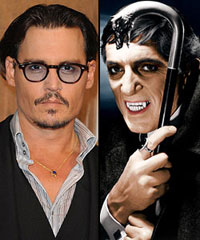
ohnny Depp and Tim Burton to Vamp It Up in 'Dark Shadows'

by Matt McDaniel July 29, 2009

Alice in WonderlandThree of the most talked-about things at Comic-Con last week were vampires ("New Moon" and "True Blood"), another movie pairing director Tim Burton and Johnny Depp ("Alice in Wonderland"), and updates of cult '60s TV shows ("Doctor Who" and "The Prisoner"). So how excited fans would get if all of those elements could be combined into one movie?

Apparently, we'll find out when Burton and Depp team up for the big-screen adaptation of "Dark Shadows," the Gothic soap opera about vampires, ghosts, and monsters that ran on ABC from 1966 to 1971. Burton confirmed this last Thursday when he presented footage from "Alice in Wonderland" to a capacity crowd at Comic-Con's cavernous Hall H. He said "Dark Shadows" would be his next project, "if I ever finish this one here."

Before Lestat, Angel, and Edward Cullen, there was Barnabas Collins, a 175-year-old vampire who stalked the town of Collinsport, Maine pining for his lost love. Originally, the character of Barnabas, played by Jonathan Frid, was only intended for a 13-week story arc on "Dark Shadows," but he caused such a sensation with viewers he became the lead character for the next four years. The show spawned two movies in the early '70s, a revived series in 1991, and a pilot that was not picked up for series in 2004.

Depp would play Barnabas, a role he told Collider.com has been "a lifelong dream for me." Depp has said he loved the show as a child: "I was obsessed with Barnabas Collins. I have photographs of me holding Barnabas Collins posters when I was five or six." Depp has been pursuing the movie adaptation for years, buying the remake rights through his production company, Infinitum-Nihil.

Burton has also spoken about his fascination with the original show. He told the Los Angeles Times, "It had the weirdest vibe to it. I'm sort of intrigued about that vibe." He also spoke about the recent influx of vampire movies: "It's like any great fable or fairytale, it's got a power to it... There's something symbolic about it that touches people in different ways."

While both Depp and Burton seem excited to start work on what will be their eighth collaboration, production might have to wait until after Depp finishes work on the fourth "Pirates of the Caribbean" movie. Disney's Head of Production Oren Aviv said in an interview with ComingSoon.net that filming will start in April or May of next year, with a release planned for 2011. Aviv says the intention for the next movie is to "scale it down, because we can't get bigger... I want to kind of reboot the whole thing and bring it down to its core, its essence, just characters."

So it may be a while before Depp bares his fangs as a vampire. If "Dark Shadows" also hits theaters in 2011, it could be up against the final "Twilight" film, "Breaking Dawn." But if it's delayed another year, audiences might be over their bloodsucker addiction. Still, it seems that if anyone can create a dark, atmospheric, and entrancing vampire tale, it would be Johnny Depp and Tim Burton. To preview the fantastic sights of their version of "Alice in Wonderland" coming next March, watch the teaser trailer below.

Thursday, July 23, 2009

What parent would let a child chew on their shoes?

Buster Brown Recalls 1.4 Million Children's Clogs

Email thisPosted Jul 22nd 2009 at 3:35PM by Bee-Shyuan Chang

Filed under: Style in the News

Buster Brown has recalled 1.4 million pairs of clogs. Photo: U.S. Consumer Product Safety Commission

According to a release published yesterday (July 21) by the U.S. Consumer Product Safety Commission, children's shoe wear company Buster Brown & Co. announced a voluntary recall 1.4 million pairs of clogs for kids.
The company has specifically focused on car-shaped footwear that features decorative wheels that can detach and possibly choke a child. Although no serious injuries have been reported, Buster Brown reps have received two reports that the wheel fallen off.
Manufactured in China, the shoes were carried at outlets such as Walmart and Amazon.com.
"Brown Shoe is committed to our customers' safety," said the company's president of wholesale Gary Rich in a written statement. "Once we realized that the wheel component could create a choking hazard among children, we volunteered to undertake the recall. We have partnered with the Consumer Product Safety Commission to ensure parents have the information they need to return the shoes for a full refund."

No bids on the Watergate

Published: Wednesday, July 22, 2009

Bidders don't bite on The Watergate Hotel

Bidders interested in The Watergate Hotel apparently didn't think the building was a steal.
The Washington, D.C.-based hotel, made famous in the Nixon era, went to auction Tuesday, but failed to attract a bid and has been taken back by the lender that holds the $40 million note on it.
PB Capital Corp. took back the property Tuesday after bidding opened at $25 million and there were no takers. The 30-day foreclosure notice, sent to hotel owner Monument Realty, expired Thursday.
The hotel, part of a larger Watergate complex, gained notoriety in the 1972 burglary that led to Nixon's resignation.
-- Associated Press

Monday, July 20, 2009

Wednesday, July 08, 2009

Leaf Silhouette

How to Make a Leaf Silhouette Portrait

Image caption for image readers
Extra photos for bloggers: 1, 2

Forget photosynthesis. Leaves are for photo-projects-thesis!

Grab a photo and a leaf, and in few simple steps you can turn everyday foliage into a unique silhouette portrait of someone you love.

Simple and elegant, leaf silhouettes look great in a frame or on a book or a card.

So, as Biff would say, “make like a tree and get to work on a silhouette leaf portrait!”

How to Make Your Very Own Leaf Silhouette Portrait

INGREDIENT LIST

lpingredes

  • A photo of someone in profile
  • A big leaf
  • Wax paper
  • A stack of heavy books
  • One pen
  • X-acto knife
STEP ONE: PREP THE LEAF

lpstep1Once you’ve found the perfect leaf (we found your basic ivy to be a great size and thickness), store it between two sheets of wax paper near the bottom of a big stack of heavy books. This will keep your leaf from drying out all crinkly, rendering it useless for this project.

STEP TWO: OUTLINE YOUR SUBJECT

lpstep2Grab your profile photo and use a pen to draw a line around the figure you intend to cut out. This allows you to make imortant decisions about which fly-away hairs to include, or not, before you get to the tricky business of cutting…

STEP THREE: CUTTING OUT YOUR STENCIL

lpstep3Use an x-acto knife to cut out your subject, carefully following the line you just drew.

Word on the street is that some folks prefer to use the x-acto knife’s double-bladed cousin, Scissors, for this step. Just use what you’re most comfortable with.

STEP FOUR: TRACE ONTO THE LEAF

lpstep4Place your photo-stencil face down on the back of the leaf. Be sure to center the stem through the middle of your stencil. Take up your pen again, and trace around the stencil.

STEP FIVE: CUT IT OUT

lpstep5This is going to feel a lot like step three… Use an x-acto knife to cut out your subject, carefully following the line you just drew.

STEP SIX: PRESS THE LEAF

lpstep6Return your lovely leaf shilouette portrait to its place between wax paper at the bottom of a stack of books.

When it has finished drying out, it will be nice and flat. Voilá! Leafy silhouette portrait accomplished!

HERE IT IS:

lpcardbig

TAKE IT FURTHER
  • Frame a portrait of a friend and give it as a gift.
  • Make a family tree with leaf shillouette portraits of the whole family.
  • Write your contact info on a leaf silhouette self-portrait for a truly unique carte de’ visite.
  • Glue one to the front of a birthday/thank you/arbor-day card.

Thursday, July 02, 2009

Code cracked 200 years later

By RACHEL EMMA SILVERMAN

For more than 200 years, buried deep within Thomas Jefferson's correspondence and papers, there lay a mysterious cipher -- a coded message that appears to have remained unsolved. Until now.

The cryptic message was sent to President Jefferson in December 1801 by his friend and frequent correspondent, Robert Patterson, a mathematics professor at the University of Pennsylvania. President Jefferson and Mr. Patterson were both officials at the American Philosophical Society -- a group that promoted scholarly research in the sciences and humanities -- and were enthusiasts of ciphers and other codes, regularly exchanging letters about them.

View Full Image

Two Centuries On, a Cryptologist Cracks a Presidential Code

University of Pennsylvania Archives

Robert Patterson

In this message, Mr. Patterson set out to show the president and primary author of the Declaration of Independence what he deemed to be a nearly flawless cipher. "The art of secret writing," or writing in cipher, has "engaged the attention both of the states-man & philosopher for many ages," Mr. Patterson wrote. But, he added, most ciphers fall "far short of perfection."

To Mr. Patterson's view, a perfect code had four properties: It should be adaptable to all languages; it should be simple to learn and memorize; it should be easy to write and to read; and most important of all, "it should be absolutely inscrutable to all unacquainted with the particular key or secret for decyphering."

Mr. Patterson then included in the letter an example of a message in his cipher, one that would be so difficult to decode that it would "defy the united ingenuity of the whole human race," he wrote.

There is no evidence that Jefferson, or anyone else for that matter, ever solved the code. But Jefferson did believe the cipher was so inscrutable that he considered having the State Department use it, and passed it on to the ambassador to France, Robert Livingston.

The cipher finally met its match in Lawren Smithline, a 36-year-old mathematician. Dr. Smithline has a Ph.D. in mathematics and now works professionally with cryptology, or code-breaking, at the Center for Communications Research in Princeton, N.J., a division of the Institute for Defense Analyses.

A couple of years ago, Dr. Smithline's neighbor, who was working on a Jefferson project at Princeton University, told Dr. Smithline of Mr. Patterson's mysterious cipher.

Dr. Smithline, intrigued, decided to take a look. "A problem like this cipher can keep me up at night," he says. After unlocking its hidden message in 2007, Dr. Smithline articulated his puzzle-solving techniques in a recent paper in the magazine American Scientist and also in a profile in Harvard Magazine, his alma mater's alumni journal.

The "Perfect" Cipher?

View Interactive

The code, Mr. Patterson made clear in his letter, was not a simple substitution cipher. That's when you replace one letter of the alphabet with another. The problem with substitution ciphers is that they can be cracked by using what's termed frequency analysis, or studying the number of times that a particular letter occurs in a message. For instance, the letter "e" is the most common letter in English, so if a code is sufficiently long, whatever letter appears most often is likely a substitute for "e."

Because frequency analysis was already well known in the 19th century, cryptographers of the time turned to other techniques. One was called the nomenclator: a catalog of numbers, each standing for a word, syllable, phrase or letter. Mr. Jefferson's correspondence shows that he used several code books of nomenclators. An issue with these tools, according to Mr. Patterson's criteria, is that a nomenclator is too tough to memorize.

Jefferson even wrote about his own ingenious code, a model of which is at his home, Monticello, in Charlottesville, Va. Called the wheel cipher, the device consisted of cylindrical pieces, threaded onto an iron spindle, with letters inscribed on the edge of each wheel in a random order. Users could scramble and unscramble words simply by turning the wheels.

But Mr. Patterson had a few more tricks up his sleeve. He wrote the message text vertically, in columns from left to right, using no capital letters or spaces. The writing formed a grid, in this case of about 40 lines of some 60 letters each.

Then, Mr. Patterson broke the grid into sections of up to nine lines, numbering each line in the section from one to nine. In the next step, Mr. Patterson transcribed each numbered line to form a new grid, scrambling the order of the numbered lines within each section. Every section, however, repeated the same jumbled order of lines.

The trick to solving the puzzle, as Mr. Patterson explained in his letter, meant knowing the following: the number of lines in each section, the order in which those lines were transcribed and the number of random letters added to each line.

The key to the code consisted of a series of two-digit pairs. The first digit indicated the line number within a section, while the second was the number of letters added to the beginning of that row. For instance, if the key was 58, 71, 33, that meant that Mr. Patterson moved row five to the first line of a section and added eight random letters; then moved row seven to the second line and added one letter, and then moved row three to the third line and added three random letters. Mr. Patterson estimated that the potential combinations to solve the puzzle was "upwards of ninety millions of millions."

[Thomas Jefferson]

Thomas Jefferson

After explaining this in his letter, Mr. Patterson wrote, "I presume the utter impossibility of decyphering will be readily acknowledged."

Undaunted, Dr. Smithline decided to tackle the cipher by analyzing the probability of digraphs, or pairs of letters. Certain pairs of letters, such as "dx," don't exist in English, while some letters almost always appear next to a certain other letter, such as "u" after "q".

To get a sense of language patterns of the era, Dr. Smithline studied the 80,000 letter-characters contained in Jefferson's State of the Union addresses, and counted the frequency of occurrences of "aa," "ab," "ac," through "zz."

Dr. Smithline then made a series of educated guesses, such as the number of rows per section, which two rows belong next to each other, and the number of random letters inserted into a line.

To help vet his guesses, he turned to a tool not available during the 19th century: a computer algorithm. He used what's called "dynamic programming," which solves large problems by breaking puzzles down into smaller pieces and linking together the solutions.

The overall calculations necessary to solve the puzzle were fewer than 100,000, which Dr. Smithline says would be "tedious in the 19th century, but doable."

After about a week of working on the puzzle, the numerical key to Mr. Patterson's cipher emerged -- 13, 34, 57, 65, 22, 78, 49. Using that digital key, he was able to unfurl the cipher's text:

"In Congress, July Fourth, one thousand seven hundred and seventy six. A declaration by the Representatives of the United States of America in Congress assembled. When in the course of human events..."

That, of course, is the beginning -- with a few liberties taken -- to the Declaration of Independence, written at least in part by Jefferson himself. "Patterson played this little joke on Thomas Jefferson," says Dr. Smithline. "And nobody knew until now."

Write to Rachel Emma Silverman at rachel.silverman@wsj.com

Wednesday, July 01, 2009

Yikes

Sears Tower unveils 103rd floor glass balconies

AP

Anna Kane, 5, of Alton, Ill. lays down on AP – Anna Kane, 5, of Alton, Ill. lays down on 'The Ledge,' the new glass balconies suspended 1,353 feet (412 …

By KAREN HAWKINS, Associated Press Writer Wed Jul 1, 5:05 pm ET

CHICAGO – Visitors to the Sears Tower's new glass balconies all seem to agree: The first step is the hardest.

The balconies are suspended 1,353 feet in the air and jut out four feet from the building's 103rd floor Skydeck. Their transparent walls, floor and ceiling leave visitors with the impression they're floating over the city.

"It's like walking on ice," said Margaret Kemp, of Bishop, Calif., who said her heart was still pounding even after stepping away from the balcony. "That first step you take — 'am I going down?'"

Kemp was among the visitors who got a sneak preview of the balconies Wednesday. "The Ledge," as the balconies have been nicknamed, open to the public Thursday. Visitors are treated to unobstructed views ofChicago from the building's west side and a heart-stopping vista of the street and Chicago River below — for those brave enough to look straight down.

John Huston, one of the property owners of the Sears Tower, even admitted to getting "a little queasy" the first time he ventured out. But 30 or 40 trips later, he's got the hang of it.

"The Sears Tower has always been about superlatives — tallest, largest, most iconic," he said. "Today is also about superlatives. Today, we present you with 'the Ledge,' the world's most awesome view, the world's most precipitous view, the view with the most wow in the world."

The balconies can hold five tons, and the glass is an inch-and-a-half thick, officials said. Sears Tower officialshave said the inspiration for the balconies came from the hundreds of forehead prints visitors left behind on Skydeck windows every week. Now, staff will have a new glass surface to clean: floors.

"It's very scary, but at the same time it's very cool," said Chanti Lawrence of Atlanta, adding that she's made her first step toward overcoming her fear of heights.

Adam Kane, 10, of Alton, Ill., rushed to the ledge with his friends and siblings, and they each eagerly pressed their faces to the glass bottom.

"Look at all those tiny things that are usually huge," Adam said.

The balconies are just one of the big changes coming to the Sears Tower. The building's name will change to Willis Tower later this summer. Last week, officials announced a 5-year, $350 million green renovation complete with wind turbines, roof gardens and solar panels.

With the ledge, visitors like Kemp said the nation's tallest building has succeeded in creating something they've never seen before.

"I had to live 70 years for a thrill like this," she said.